

Meta Muse: Turning a Personal AI into a Computer That Keeps Working
Muse is interesting because it is not another chat window. Meta presents it as a personal AI agent with a persistent computer for each user. Give it a goal or an everyday task; it plans, uses tools, operates a browser, and pauses when a human decision is required.
From chat to a continuing task
A conventional chat model often has the lifetime of one request and one answer. Muse is closer to a long-lived task session: messages can arrive from mobile, Mac, or WhatsApp while the agent continues inside its own Secure VM. The VM is an isolated Linux computer with a full browser, persistent storage, CPU, and memory. The user can intervene at any point.
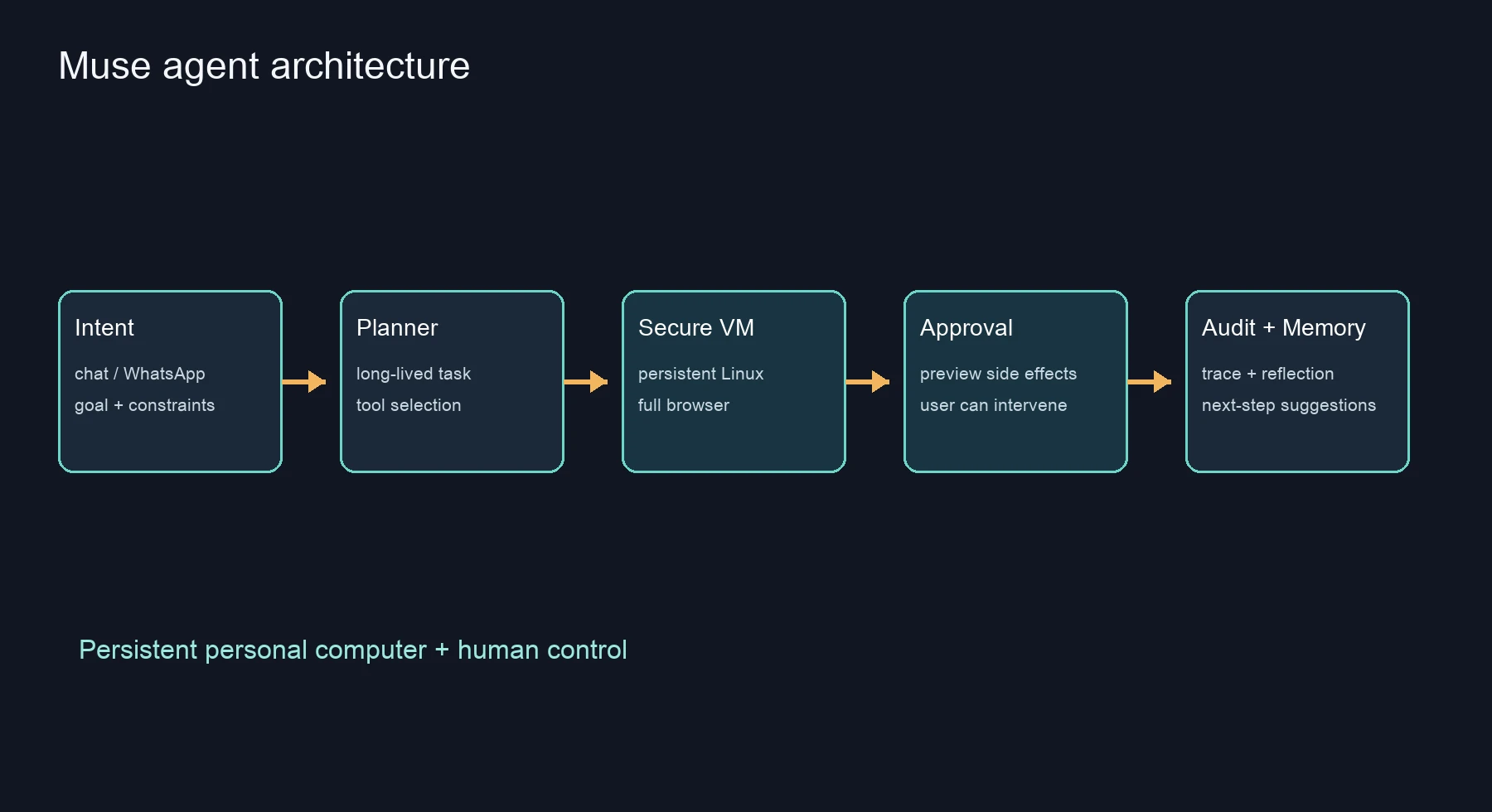
The task loop can be summarized as:
goal and constraints
  → decomposition and planning
  → browser / application actions
  → side-effect preview and approval
  → result written to memory and audit trail
The important shift is that plans, tools, and state do not disappear when a single response ends. An instruction such as “keep an eye on this goal” can become a sequence of actions rather than a prompt that must be re-explained every time.
Why a Secure VM matters
Giving an agent direct control of a personal computer exposes browser cookies, files, SSH keys, and payment information to a high-privilege process. Muse instead assigns each user an isolated Secure VM and places the browser and working files there. The agent gets enough CPU, memory, storage, and persistence to do real work while the host system remains outside its execution boundary.
This changes the browser-agent abstraction. It is no longer a stateless Playwright script; it is a runtime with a work directory, login state, recovery, and a human handoff point. A user can inspect the browser, take over one action, and return control to the agent.
Tools as an extensible capability surface
The product describes connections to email, calendars, Instagram, and other everyday applications. It also says that when a task needs a tool that does not exist, the agent can build one. The engineering question is therefore not whether a model can write code, but whether generated tools have explicit inputs, outputs, credential scopes, and side effects inside a bounded workspace.
A robust loop separates observation, planning, and action:
- Observe the current page, application state, and previous result.
- Propose the next action and a verifiable completion condition.
- Preview side-effecting actions such as sending mail or making a purchase.
- Execute after approval and append the result to the audit trail.
- Preserve the scene on failure so the user can retry, intervene, or revise the plan.
Human control is more than a dialog box
Muse treats email sending and purchases as approval points, while showing what the agent has done and what it plans to do next. This is stronger than a generic confirmation dialog because the user needs context, target, and side-effect information.
Credential isolation is part of the same design. The product describes a secure credential store that the agent cannot see; for shopping, a one-time card number can hide the real card from both the merchant and the agent. Least privilege is therefore a runtime property made from credentials, VM boundaries, tools, and approval events.
Memory for continuity
Muse's memory is not simply a larger chat transcript. The product says it learns from conversations, reflects on what matters, and suggests ideas around actual needs. A useful implementation separates at least three layers:
- Facts: information and preferences the user explicitly supplied.
- State: task progress, completed actions, and approvals still pending.
- Reflection: strategies that worked and preparations that may help next time.
Keeping facts, state, and reflection separate is what lets an agent recover a long task without treating an outdated message as current truth.
How it differs from neighboring agents
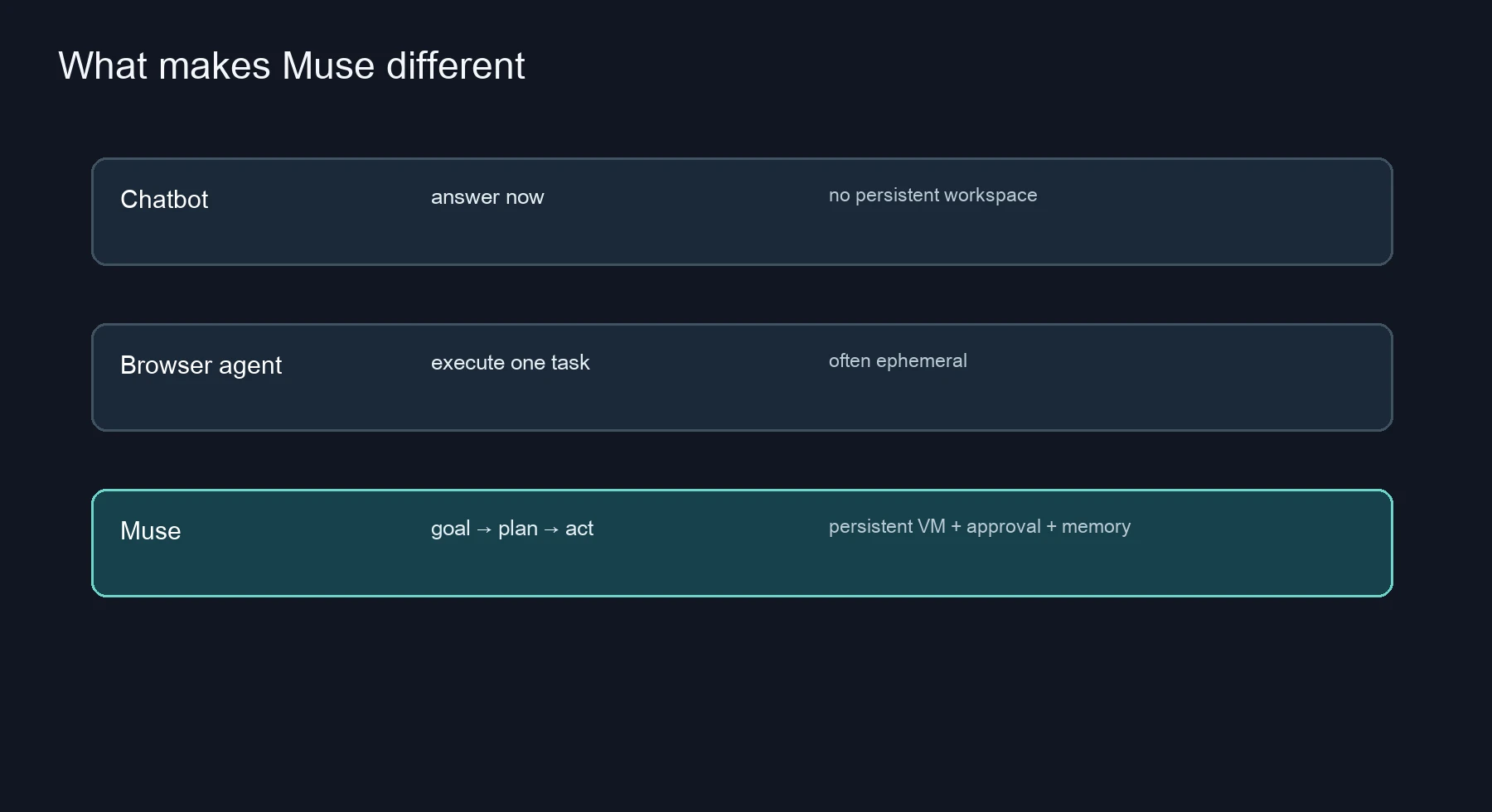
A chatbot is good at immediate answers but has no persistent workspace. A browser agent can complete one website task but often loses its scene when the task ends. A desktop automation tool has local power but rarely unifies permission, approval, and audit. Muse combines a persistent VM, browser, tool building, approvals, and memory, moving the agent from answer generator toward a collaborator inside a personal computing environment.
That combination creates hard systems questions: how do long tasks avoid loops, how are abandoned resources reclaimed, how can memory be deleted and explained, what happens to approvals while the user is offline, and how can the system prove that a purchase actually happened? Muse's distinctive engineering is the decision to put these problems in the product data flow.
Engineering takeaway
The most reusable idea in Muse is its runtime contract. The model can change, the browser library can change, and the messaging surface can change. Task state, tool contracts, approval events, credential scopes, and audit records should remain stable. For teams building personal agents, this runtime boundary matters more than choosing a larger model.
References: Muse and Meta AI. Muse's model weights, internal scheduler, and complete infrastructure are not public; this article separates public product behavior from architectural inference.